What is precision agriculture? A guide for the Romanian farmer
The summer of 2024 left almost 2 million hectares of maize and sunflower hit by drought, and the Romanian state paid out €500–600 million in compensation. In an increasingly unpredictable climate, decisions made “by guesswork” — when to irrigate, how much to fertilise, where to step in — cost more and more. This is exactly where precision agriculture comes in.
If you’ve heard the term but dismissed it as an expensive marketing promise reserved for big corporations, this guide is for you. We’ll explain, briefly and without jargon, what precision agriculture is, how it works, what you concretely gain, and how to start without getting burned.
What precision agriculture actually is
Precision agriculture means making decisions for each parcel — sometimes for each zone within a parcel — based on measured data, not on averages or habit. Instead of treating the whole field the same (the same water rate, the same amount of fertiliser, on the same day), you apply the right resource, in the right place, at the right time, in the right amount.
The core idea is simple: soil, moisture and crop condition differ from one end of the field to the other. A sensor or a satellite image shows you these differences, and you decide based on what’s actually happening in the field — not on how the land looked last year, nor on what your neighbour is doing. It isn’t “farming of the future” or science fiction: it’s simply farming based on measurement.
Why it matters now, in Romania
Local context makes all the difference. Drought is no longer an isolated accident but a pattern: in 2024, almost 2 million hectares of spring crops were affected, with major losses in maize and sunflower. Water is becoming the critical resource, and irrigation systems cover only part of the country. At the same time, margins keep getting thinner — every litre of diesel, every kilogram of fertiliser and every irrigation round counts. We covered separately what drought means for the 2026 season and what a data-driven anti-drought strategy looks like.
It’s no coincidence that 2025 was seen as a turning point for digital agriculture: the moment technology moved from “optional tool” to risk-management infrastructure. Romanian farmers remain pragmatic, and rightly so: they invest only when they see confirmed results, not promises. That’s a healthy attitude — and exactly why precision agriculture deserves to be judged by numbers, not slogans.
How it works: the core technologies
Behind the term are a few technologies that work together:
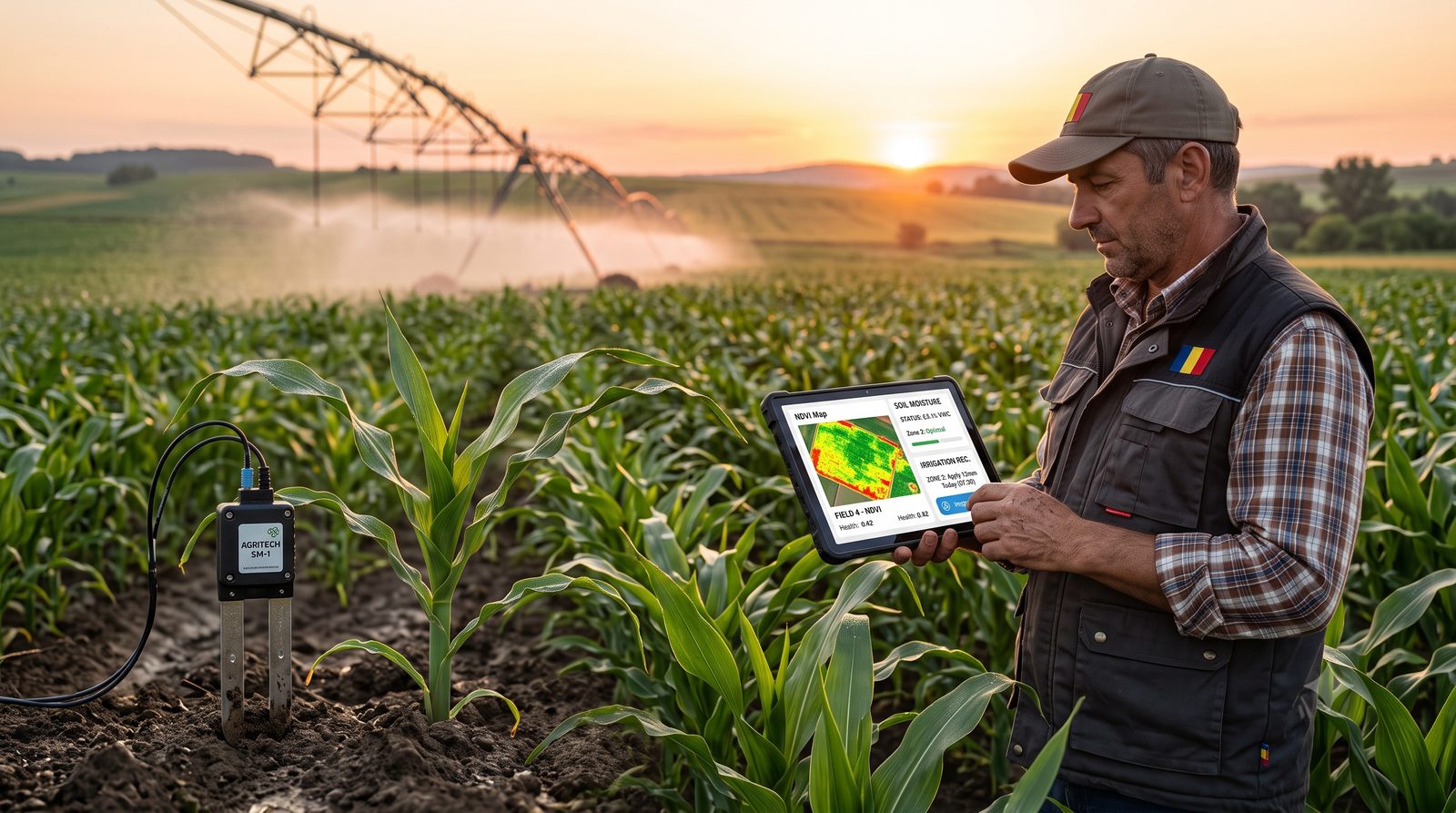
- Soil sensors — measure moisture, temperature and salinity right at root depth. Transmitted over LoRaWAN networks, they show you in real time how much water the plant actually has available. (See how many sensors you need on a farm.)
- Satellite imagery and vegetation indices — such as NDVI, which reveals crop condition and stress across the whole field, sometimes before the problem is visible to the naked eye.
- Weather data and evapotranspiration — estimate how much the crop consumes and how much water it needs, using internationally recognised methodologies such as FAO-56.
- Variable-rate application (VRT) — lets you dose water, seed or fertiliser differently by zone.
- Alert and decision systems — turn raw data into clear warnings: “irrigate parcel X”, “water stress on zone Y”.
You don’t need all of it from day one. Most farms start with soil and water monitoring — the most expensive problem — and add the rest as they see results. If you’re wondering at what point it’s worth it, we wrote about when to install a monitoring system.
What you actually gain: the numbers
The benefits aren’t theoretical. A 2025 meta-analysis, pooling 85 studies and 1,472 farms worldwide, found that precision agriculture raises return on investment (ROI) and net profit, while improving nitrogen efficiency and cutting pesticide use.
Another study, by AEM together with the consultancy Kearney (updated in 2026), quantified the effects directly in the field: +5% productivity, −8% fertiliser, −9% herbicide, −5% water and −7% fuel.
Two things deserve honest emphasis. First: the gains are significantly larger on big farms, over 100 hectares — exactly the profile of many commercial operations in Romania. Second: they aren’t a “lottery win” but benefits that accumulate season after season, as you learn to use the data. The technology doesn’t decide for you — it gives you the information so you can decide better.
How to start without getting burned
Practical advice, tested by farmers who have already been through it:
- Start with a single problem. Most often, water: where and when to irrigate. It’s the area with the highest cost and the fastest visible result.
- Measure before and after. Without a baseline, you can’t tell whether the technology earned its cost. Record water use, inputs and yield on the pilot parcel.
- Ask for evidence, not promises. Ask about results on similar farms, in similar conditions. Scepticism is an advantage, not a flaw.
- Expand once it pays off. Add parcels, sensors or new features only after the first investment has proven its value.
When you choose a partner, look at a few essentials: is there local support and data in your language? Is the data hosted in the EU, GDPR-compliant? Is there real agronomy behind the numbers, or just a pretty dashboard? These separate a useful tool from an expensive gadget.
Conclusion: data, not guesswork
Precision agriculture doesn’t mean giving up your experience as a farmer — it means complementing it with data that confirms or refutes what you sense about the field. In a country where drought has become the rule and margins keep tightening, deciding on the basis of measurements — not “by guesswork” — is no longer a luxury but a form of economic common sense.
At iotferma.ro we build exactly this: soil and water monitoring, tailored to farms in Romania, with local-language data and local support. If you want to see how it looks in practice, start with a single parcel.
Frequently asked questions
Is precision agriculture only for large farms? No. The benefits are indeed larger at scale, but any farm can start with a single problem parcel and expand gradually as it sees results.
How much does it cost to start? It depends on the area and the chosen technology, but most farms start with a soil-monitoring system on a pilot parcel and recover the investment from water and input savings.
How do I know if it’s worth it for my farm? Test a single parcel for one season. Compare water use, inputs and yield against a conventionally managed parcel — the numbers will tell you clearly whether it makes sense to expand.