The future of farming, built on data · Romania
Precision soil monitoring
& irrigation
Protect your harvest from drought — we handle everything.
Technology that's rare in Romania: soil sensors at the crop's roots, FAO-56 irrigation planning and satellite imagery — all in one platform, with alerts in Romanian.
A maize field seen from above, Brăila 2024
Brăila · the 2024 season
14 July 2024 · day 85 after sowing
Tasselling: this is when it needs the most water.

An example with the real 2024 weather of Brăila. The field, the probes, the waterings and the yield are simulated; the yield is an estimate, not a promise. Potential with no water shortage: 13 t/ha on the watered fields, 11 t/ha on the unwatered one, as in the app. Usual watering: three 50 mm passes, at 12 leaves, at flowering and early in grain fill, what an irrigated hectare in Romania usually gets (ANIF: 2–3 waterings a season). 2024: close to normal April–September rain (230 mm), but 26 days at 35 °C or more, nearly three times the usual.
How the yield model was trained
The yield loss comes from the soil water, worked out day by day from the probes and the weather with the UN's standard method for agriculture (FAO), and from the days at 35 °C or more. What each costs was learned from yields reported separately for irrigated and rain-fed fields: maize by county in the US (the US Department of Agriculture, 1996–2024) and by département in France (Agreste, 2000–2025). Romanian data is kept out of training so it can serve as the test: county yields from the National Institute of Statistics (INS, 1996–2025), nine field trials with watered and unwatered plots, and satellite images (Sentinel-2).
How it works
From the field to your phone, in three steps
Sensors in the field
Sensor stations measure soil moisture, temperature and salt in the soil (conductivity) at 30 cm, and the deep stations also at 60 cm (on every parcel, on both plans); for maize, wheat, durum wheat, rye, barley, rapeseed, soybean and sorghum on irrigated parcels, the Pro plan can add a third probe at about 90 cm. They send the data over a long-range radio signal (LoRaWAN): batteries that last years, kilometres of range, no cables.
Data in real time
Readings land on EU servers, where they are judged against your parcel's soil type — the "too dry" line for clay is not the same as for sand.
Clear decisions
See every parcel's status on the map, get the irrigation plan, and receive e-mail alerts when something is off.
Installation
We install. You open the app.
The equipment is ours, so installation and maintenance are our job — all included in the subscription.
Setup and training
We prepare the platform for your farm — parcels, crops, soil textures — and show you how it works.
The station that gathers the data (gateway), on a mast
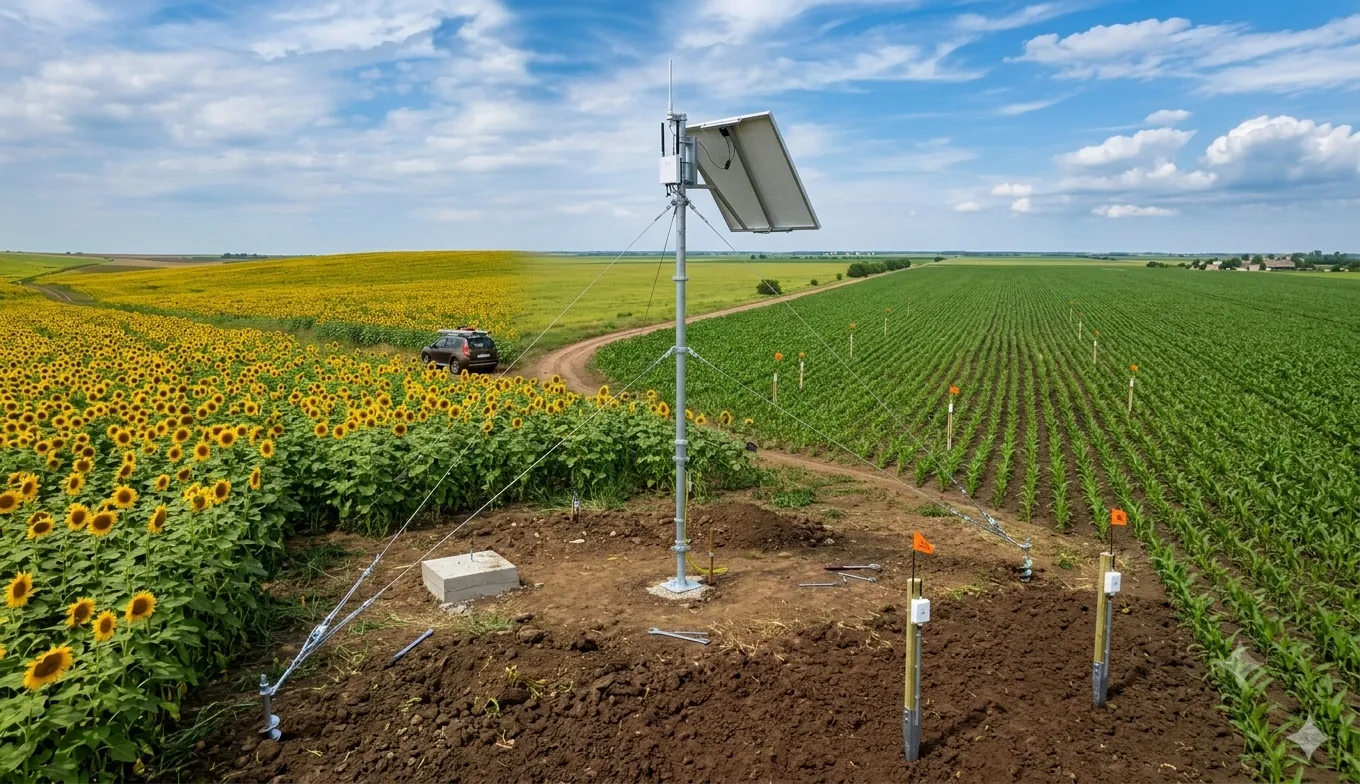
A 6 m mast on a ground screw, solar panel and battery — the station that gathers the field data (gateway) runs off the grid, no mains power, with a 4G link.
Local weather station
An 8-in-1 station, mounted on a mast in the field, no foundation needed: temperature, humidity, wind, rain — this is where we learn how much water the crop loses through evaporation (ET₀) and the irrigation plan comes from.
Sensors in the furrow
Soil stations are buried at the depth your crop needs and calibrated on site, then checked yearly.
Features
Built for Romanian farms
Moisture at root depth
Moisture, temperature and salt in the soil (conductivity), at 30 cm and, on the deep stations, at 60 cm — plus an optional third probe at about 90 cm on the Pro plan for deep-rooted crops on irrigated parcels. Thresholds for six soil types.
Irrigation planning with the FAO-56 method
Each day we work out how much water the crop loses through evaporation (ET₀), how much it rains and the crop's growth stage — then tell you when to irrigate, how much, and on which parcel. It's the FAO-56 method, the international standard for crop water need; for maize, the day to irrigate follows the University of Nebraska's stage-by-stage thresholds.
Alerts in Romanian
Over 30 alarm types on three severity tiers (critical, major, warning), delivered by e-mail and phone notification in Romanian — drought, waterlogging, frost, heat, wind, disease, salinity, batteries and sensors that went silent. With quiet hours, so the soil never wakes you at night.
Data hosted in the EU
EU infrastructure, GDPR-compliant. Your farm's data stays yours.
Reports and yield estimate
A season report per parcel: water balance, yield estimate and its value at indicative prices.
Privacy
Your farm's data never leaves the EU
Servers run in European Union data centres and e-mail is sent through a relay hosted in France. GDPR compliance from day one — no compromises, no transfers outside the EU.
See the platform with your data
Book a 30-minute demo, or step into the live demo with sample data on your own.