Drought in 2026 farming: what the soil tells you before the crop shows stress
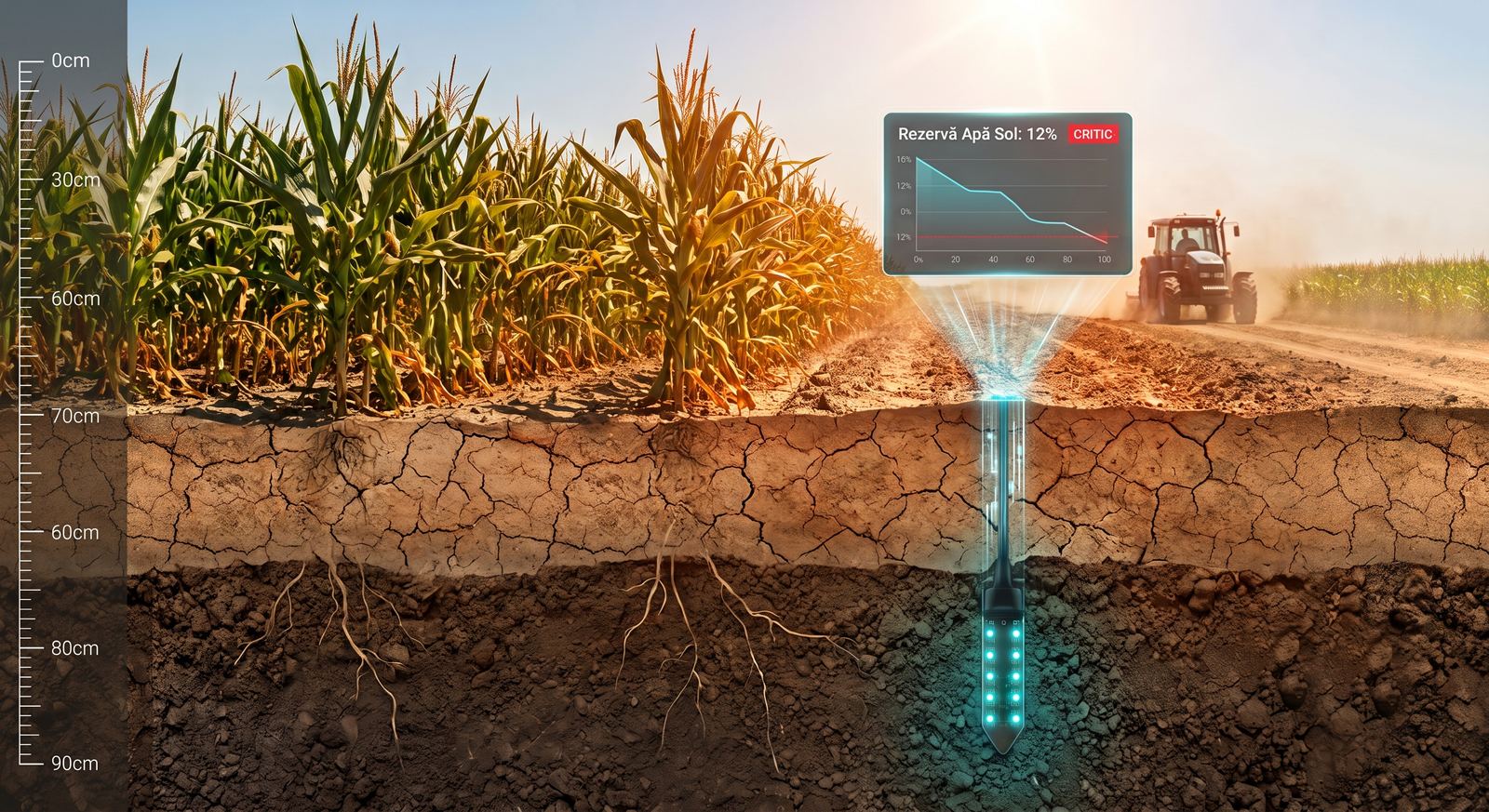
Drought has become the variable that decides the season in Romanian farming. It’s no longer an exceptional event — it’s a scenario you plan for. And the lesson every dry year teaches is the same: drought doesn’t start when you can see it. By the time maize leaves curl at midday, the plant has already been losing yield for a week or two. The battle is fought earlier — in the soil’s water reserve, where the naked eye can’t look.
Soil drought comes before field drought
The soil works like a reservoir: between “field capacity” (how much it can hold) and the crop’s stress threshold there’s a reserve that drains day by day through evapotranspiration. A 10–15 mm summer shower wets the top few centimetres and briefly greens the crop — but at 60–90 cm, where maize roots sit in July, the reserve keeps falling.
That explains the two classic dry-year mistakes: irrigating too late, because you watched the plant instead of the soil; or irrigating for nothing, because the surface looked dry while the depth still held water. Both cost you — one in yield, the other in water and fuel.
Which crops cope better with drought
Not all crops lose equally. As a general agronomic guide:
- Sorghum is the drought-tolerance champion — deep roots and a metabolism that “pauses” in heat rather than dying.
- Sunflower explores water down to 80–120 cm and tolerates moderate deficit well.
- Barley and wheat have the calendar on their side: they do most of their season on the winter–spring reserve and escape the peak heat.
- Maize is the most exposed: its critical window (pollination to grain fill) lands right on the July–August drought peak — it’s the crop where irrigation timing forgives the least.
- Rapeseed and soybean sit in between: sensitive at establishment and flowering, but with compensation strategies.
Just as important: hybrid and sowing date. An earlier-maturing hybrid sown early “runs away” from the drought peak — you shift the plant’s calendar so peak water demand doesn’t overlap with minimum soil water.
What you can do now, mid-season
In July you can’t change the hybrid — but three things are still in your hands:
- Measure the real reserve, not the appearance. The gap between “the field looks OK” and “I have 10 days of reserve left at the root” is exactly the gap between a timely decision and a late one. Soil moisture sensors, installed at root depth and calibrated to your soil texture, give you the number — not the impression.
- Prioritise fields. When water and time are limited, the question isn’t “irrigate or not?” but “which field needs it first?”. A map of the real water status per field turns a dilemma into a work list.
- Irrigate on a balance, not a calendar. The FAO-56 water balance — how much the crop loses per day, how much it rained, how much the soil still holds — tells you when and how much to irrigate so every cubic metre counts.
Longer term: strategy, not reaction
A dry year isn’t won in July — it’s won in February, with the plan made. We wrote about that at length in the 4-step anti-drought strategy: from choosing crops and hybrids to sizing the monitoring network and preparing irrigation before the season.
And if you want to see what monitoring that catches drought before you spot it from the cab looks like — the platform is available in a demo version with simulated data.