Farm inspections: which records you must keep and how to keep them without writing by hand
It is the week the paying agency wires this season’s subsidies — and, as every year, it is also when inspections cluster: on-the-spot checks, conditionality checks, scheme checks. At an inspection, the question is never “did you work well?” but “can you prove you worked well?”. The difference between the two lives in a stack of records the law requires you to keep up to date — and which most farms fill in retroactively, in a hurry, the evening before.
This article is about what is concretely required and which part can be automated. Exact requirements vary by campaign and by scheme — always check the current campaign guide — but the skeleton has been stable for years.
The records inspectors usually ask for
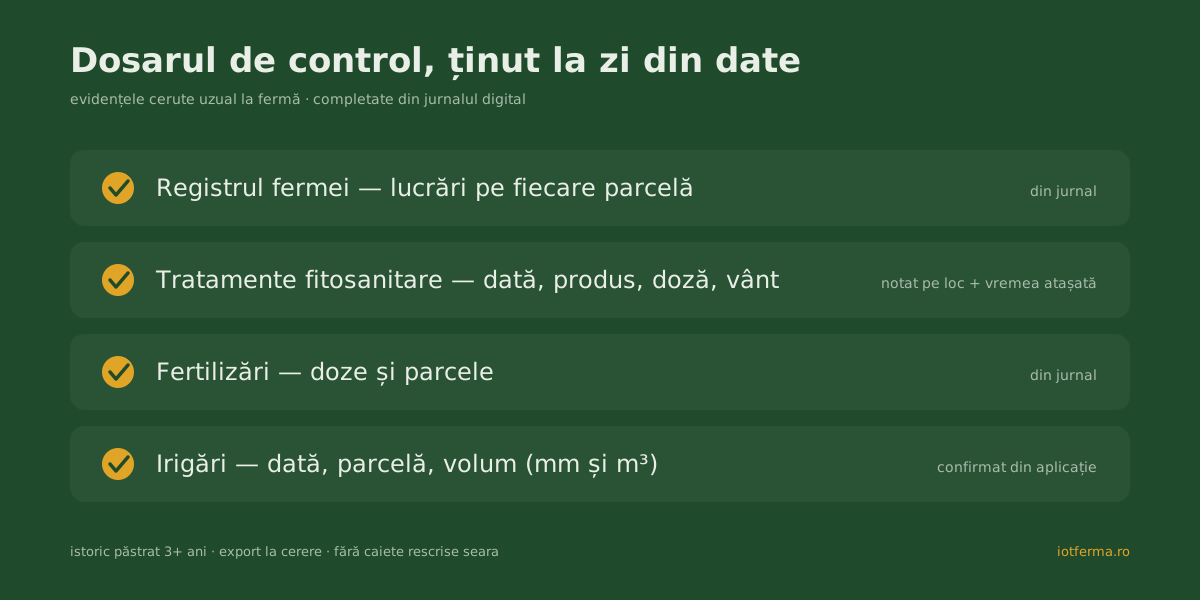
The farm register. The per-parcel record of operations: what you sowed and when, what works you carried out, what you harvested. It is the framework document APIA, Romania’s paying agency, requires for area payments — and the first thing requested at an on-the-spot check.
The plant-protection treatment register. Mandatory for any professional user of plant-protection products, kept for at least three years: date, parcel, crop, product, dose, target. Inspections also cross-check it against purchase invoices — a product bought must appear in treatments, and vice versa.
Fertilisation records. Which fertilisers, at which doses, on which parcels — with special attention to nitrogen in nitrate-vulnerable zones, where the fertilisation plan and nitrogen ceiling are checked on paper.
Irrigation records. For irrigating farms: when, on which parcel, with what volumes. It counts twice — once for water-related schemes and permits, and again as proof of good practice when you explain a crop’s condition.
Penalties for missing or incomplete records range from warnings to percentage reductions of the payment — and for plant-protection records, fines are separate and far from symbolic. But the real cost is different: without records, every conversation at an inspection starts on the defensive.
Why hand-kept records fail exactly at inspection time
Not because farmers don’t work — but because handwritten records collide with the reality of a summer day. The treatment happens at 5 am, irrigation runs at night, and the notebook stays on the desk. Three weeks later, who remembers exactly which day plot 3 was sprayed, and at what wind speed?
At an inspection, those are precisely the questions. And the gaps show: rounded dates, works logged in bulk “at month end”, treatments that don’t reconcile with invoices.
What a journal that fills itself looks like
This is the part that has changed in recent years. A monitored farm generates most of its own records, because field operations leave traces in the data:
- irrigations are logged with volume and date — you confirm an irrigation recommendation in the app and the entry lands in the journal, with millimetres applied and the cubic-metre equivalent, on that parcel;
- treatments are noted on the spot, from your pocket — with the parcel and the product, in the minute the work ends, not in the evening from memory;
- the weather at the moment of the work stays attached — the farm’s station records the wind, temperature and spray window of the treatment day. If anyone ever asks why you sprayed on Tuesday and not Wednesday, the answer is in the data: Tuesday had a window, Wednesday had wind;
- history is never lost or rewritten — three years of records means an export, not an archive of notebooks.
A digital journal does not replace the official forms — but it fills them with real data instead of reconstructions. You complete the register from the journal, not from memory. What the platform actually records is covered in what the app calculates.
Bonus: the same records defend your next subsidy
Records are not only an obligation — they are your argument. Environmental and climate schemes increasingly ask for proof of practice: that you irrigated efficiently, treated in suitable conditions, respected ceilings. The farm with this data up to date doesn’t just pass the inspection — it qualifies more easily for the schemes that pay extra.
And the discipline installs itself once it stops costing time: if record-keeping means pressing a button at the end of the work, it happens. If it means an hour at the desk in the evening, it gets postponed.
If you want to see what the farm journal looks like on a real farm — irrigations, treatments, and the weather of every operation — the platform has a demo version with simulated data.