The 2026 anti-drought strategy: an X-ray of the crisis and a 4-step plan
High-performance farming can no longer be done just by looking at the sky. When the sky turns stingy, data saves your profit — and the soil drought of 2026 is no longer an exception you escape by luck, but the new business reality you have to manage year after year.
While many farmers look to the sky in hope, high-performing farms use data to control every millimetre of water. You no longer guess when the maize is “thirsty” — you get precise data and you are alerted before the plant enters water stress.
An X-ray of the crisis: the water reserve
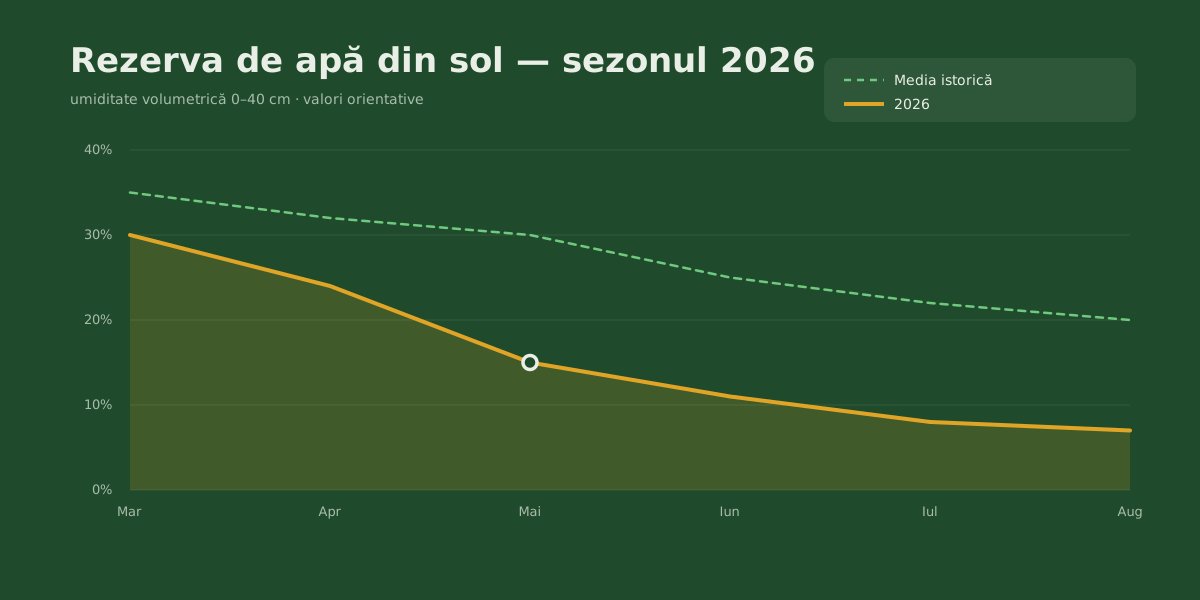
The year 2026 confirms a trend you can already feel in the field. Soil moisture has dropped well below the historical average of roughly the last 20 years, and the water reserve accessible to the roots has thinned dangerously. As a rough estimate, the regional deficit reaches around −38% in areas such as the Bărăgan and the Western Plain, and, without intervention, the wilting point for spring crops may be reached around 12 May.
What does this deficit mean in practice, beyond the figures? It means the plant uses water faster than it receives it, and the reserve at root depth empties without you seeing it at the surface. When the soil looks dry on top but still holds water at 60 cm, you irrigate for nothing. When it seems fine at the surface but the deep reserve is drained, you delay at exactly the wrong moment. The difference between a right decision and a wrong one cannot be seen with the naked eye — it is measured.
The infrastructure paradox
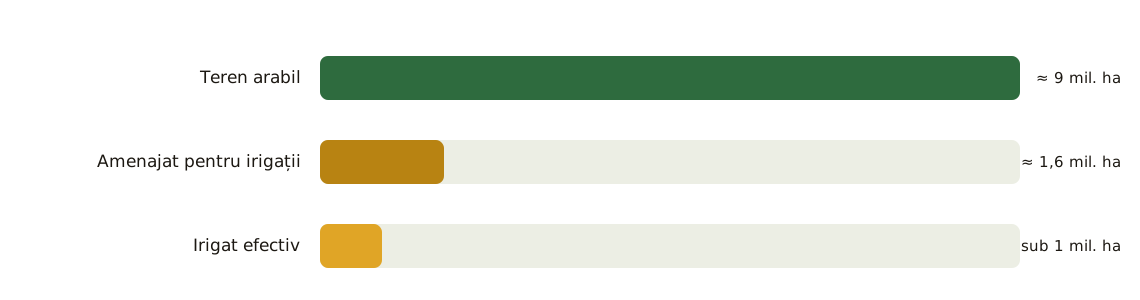
On paper, Romania is in a very strong position when it comes to resources. We have about 9 million hectares of arable land, of which roughly 1.6 million are equipped for irrigation. The problem lies in the gap between potential and reality: the area actually irrigated remains below 1 million hectares. This is the paradox you face — the infrastructure exists, but it is not working for you.
The causes of this bottleneck are familiar to anyone who has tried to get the water flowing on time:
- Ageing infrastructure: many pumping stations use 1980s technology, with large losses of pressure and energy, which make irrigation expensive and inefficient.
- Bureaucracy in the OUAI (irrigation water users’ associations): decisions and approvals delay the opening of the canals right at the critical windows, when every day of delay costs you yield.
- Low digital adoption: barely 21% of the farms that irrigate use some form of digital soil monitoring. The rest go by guesswork.
The invisible waste of “guesswork” irrigation
When you water by the calendar or by instinct, the losses are not immediately visible on the bill or in the harvest — but they add up season after season:
- Wasted energy: unoptimised irrigation cycles can waste up to 30% of the energy consumed, pumping water the soil does not need at that moment.
- Nitrogen leaching: when you apply more water than the soil can hold, it washes the nitrogen below the root zone. The fertiliser you paid for is carried out of reach, and the yield drops.
- Soil compaction: excessive, repeated watering leads to compaction and root suffocation, affecting the soil structure and its ability to breathe in the long term.
The iotferma.ro solution: from sensor to profit
The answer is not to irrigate more, but to irrigate precisely. iotferma.ro provides you with a complete system, with no upfront investment: we own, install and maintain the field equipment, and you pay an all-inclusive monthly subscription. Here is how it works, in four steps.
1. Sensors in the soil
We install LoRaWAN sensors at root depth, on two levels chosen according to the crop — from 30–50 cm for wheat up to 80–120 cm for sunflower — usually with one sensor at each end of the range. This way you see not just whether the soil is dry at the surface, but exactly where the water that the roots can truly use is located.
2. Cloud analysis
The field data reaches the cloud, where it is combined with the hyper-local weather forecast and interpreted using the FAO-56 method. The system does not just show you raw numbers — it calculates the real water requirement of your crop.
3. “Start/stop” alert
You receive clear alerts on your phone, in Romanian: when to start and when to stop irrigation. You no longer guess and you no longer worry — you are notified before the plant enters water stress.
You no longer irrigate by the calendar or by how you “feel” it might be needed. You irrigate when the data tells you the plant needs it, exactly as much as it needs — not a millimetre more, not one less.
4. Measurable savings
The result is not a vague promise, but a saving you can track. Overall, the system reduces water and energy consumption by 10–30%. As rough estimates, that means around 2,400 m³ of water saved per hectare per season and roughly 480 RON in energy per hectare. Because you do not pay for the equipment, we are not talking about depreciation or the payback period of an investment: the subscription is usually covered by the water and energy saved in a single season.
The climate has changed. Your tools have to keep pace.
The drought of 2026 is not an accident, but the direction in which Romanian agriculture is heading. You can keep relying on luck and instinct, or you can move to data-driven decisions without spending a single leu on equipment. iotferma.ro gives you control over every millimetre of water, exactly when it matters.
Frequently asked questions
Do I really not pay for the equipment? That’s right — you don’t. You pay a monthly subscription; installation, maintenance and the replacement of faulty parts are included. As a rule, the subscription is covered by the water and energy saved in a single season.
At what depth do the sensors measure? It depends on the crop: from 30–50 cm for wheat up to 80–120 cm for sunflower, usually with one sensor at each end of the range.
Where do the price and yield figures come from? The prices are official Romanian market prices, and the yield estimate uses the FAO-33 model (yield as a function of water), with a stated margin of ±15–20%.
Who handles the installation? We handle it entirely ourselves, with a temporary, removable mounting, scheduled before the season — from day one you have calibrated sensors in the field.
Are you ready to secure your 2026 season?