Drought is no longer an isolated event in Romania — it has become a business constant
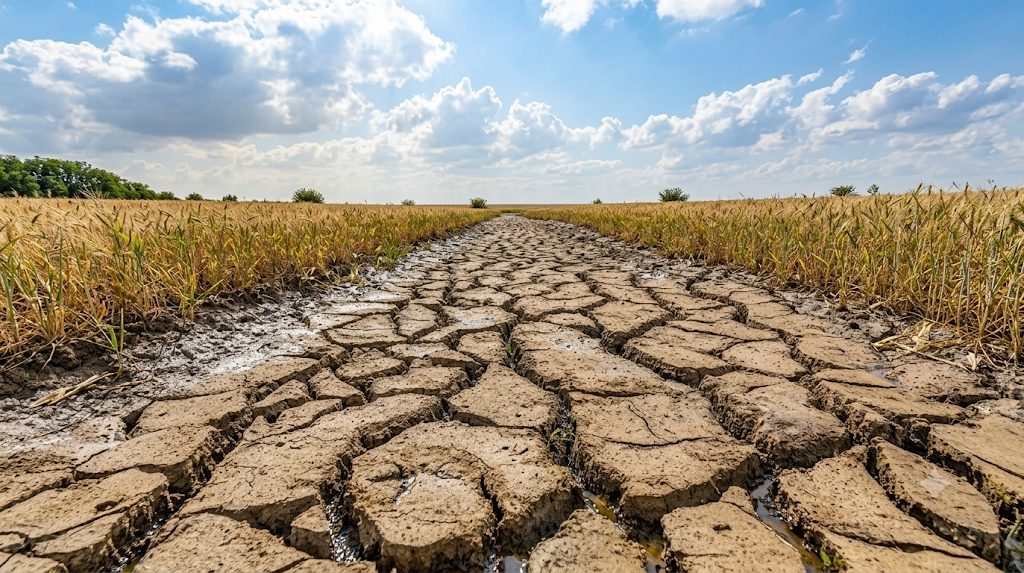
In the spring of 2026, entire regions in the west and south of the country recorded historically low rainfall, confirming meteorologists’ warnings: the climate is no longer a variable but a constant around which you have to build your entire farming strategy — otherwise you risk being knocked out of the game.
For many Romanian farmers, irrigation has always seemed like the lifeline. But the truth on the ground is far harsher: pouring water onto a field without knowing exactly what is happening below the surface of the soil has become a luxury few budgets can still afford.
Guesswork irrigation drains your budget, not just the water table
Romania has around 9 million hectares of arable land, but only about 1.6 million are equipped for irrigation. For those who do have access to water, the challenge has shifted from “do we have anything to irrigate with?” to “how much does it cost us to irrigate?”.
When the pumps start up by the calendar or by gut feeling, three costly things happen:
- Apparent dryness: the surface of the ground may look dry, but at a depth of 30–40 cm — the active root zone — the water reserve may well be optimal. Pumping at that moment does nothing for the plant; it only burns expensive electricity.
- Nutrient leaching: excess water, applied for lack of data, washes fertilisers below root level and forces you into additional applications, with extra costs.
- Premature wear: motors and pumps run for hours on end “for nothing”, which shortens their lifespan and inflates your maintenance bills.
Worth remembering: independent studies show that digital soil monitoring can cut water and energy use by 10–30% while maintaining or even increasing crop yields. Even so, barely 21% of local farms that irrigate rely on real-time data.
How iotferma.ro changes the game
High-performance farming can no longer be done simply by watching the sky. The platform turns every plot into a living organism whose needs you read straight from your phone, in real time.
Here is how we put control back in your hands:
1. Visibility at root level
Industrial-grade sensors, placed strategically within the crop, continuously measure soil moisture and temperature at several depths. You no longer have to guess when the maize is “thirsty” — you get precise data and an alert before the plant enters water stress, so you can act at the right moment.
2. Full autonomy in open fields
The lack of a GSM or Wi-Fi signal in the middle of plots covering hundreds of hectares is a classic problem of agricultural digitalisation. The sensors in the field communicate via LoRaWAN — a long-range, very low-power technology — and have an internal battery that lasts up to 10 years. You bury them in the furrow and they do their job year after year, with no cables and no expensive infrastructure to run across the land.
3. Clear decisions, all in one place
Data from the air and from the soil is processed and turned into simple charts. You see the hyper-local weather, the soil’s water reserve and your irrigation history at a glance, straight from your phone or tablet. You set your own rules — for example, you are notified exactly when moisture drops below a threshold, together with the volume of water needed to restore it (the FAO-56 method).
4. Scalability without the headaches
Whether you manage 50 or 5,000 hectares, adding new sensors is instant. As the farm grows, your data network keeps pace, without interruption.
The future of your farm starts underground
You cannot control the lack of rain, but you can control every drop of water you pump. The shift from reactive to precision irrigation is the line that separates the farmers who fight against the climate from those who thrive in spite of it.
Frequently asked questions
What does it cost? You pay an all-inclusive monthly subscription — with no upfront investment. The equipment remains our property and under our warranty, and installation and maintenance are included. You can estimate the amount in the calculator before any commitment.
Does it work without internet on the farm? Yes. The sensors communicate via LoRaWAN, over a range of kilometres; only the gateway needs a 4G signal, and its location is chosen at installation precisely on that basis.
How long do the sensors last without maintenance? They have an internal battery that lasts up to 10 years, with no cables and no infrastructure to run across the land. We check them during the annual service visit.
Do I need a building permit? No. The setup is temporary and fully removable — with no permanent foundations.
Are you ready to optimise your water and energy use and grow your profit per hectare?