
How many sensors do I need on the farm — and why one isn't enough
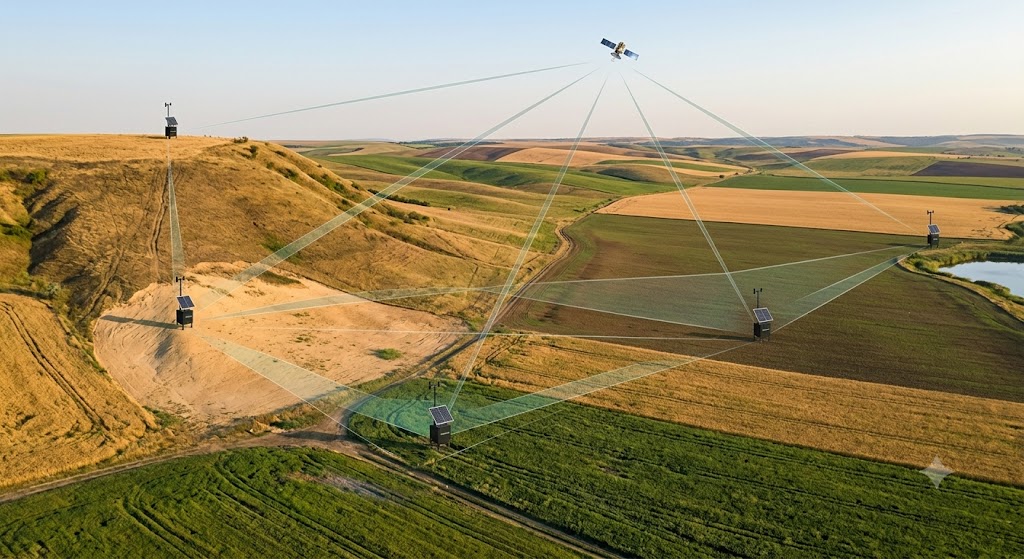
It’s one of the most common questions — and usually the first one tied to cost: “do I really need several sensors? Can’t I just put in one and be done with it?” The honest answer: the number isn’t a fixed figure, it depends on the farm — but a single sensor across a whole plot is almost never enough. Here’s why.
A plot is only as safe as its driest spot
Picture a plot with a single sensor, placed in one corner. The sensor reads 30% moisture — sounds fine. Except at the far end, on a strip of sandier soil, the crop is already under drought stress. You have no way of knowing: you have one measurement, from one point.
That’s why, when a plot has several soil-moisture stations, its condition is set by the driest layer, not by the average. You want to make the irrigation decision based on the zone that suffers first, not on the luckiest corner. More sensors mean you see the spread across the plot — and that the alarm threshold trips exactly when it should.
Soil isn’t uniform — and water doesn’t move the same everywhere
Two plots of the same size can have completely different needs, depending on soil and terrain:
- Sandy soils dry out quickly and unevenly — water seeps in and drains away, and the differences between zones are large. They call for a denser network.
- Clay soils hold water for longer and more uniformly — the thresholds are different, and the differences between points are smaller.
- Rolling terrain sends water downhill: the hilltop dries out, the foot of the slope collects it. A single measurement in the middle catches neither extreme.
- Uniform chernozem, by contrast, needs fewer sensors — precisely because it behaves the same way over large areas.
For the same reason, the drought and excess thresholds are calculated from each plot’s texture, not from universal values that mislead: 28% means something different in sand than in clay.
Depth follows the crop
The number of sensors isn’t just about area, but also about depth — and there’s no universal figure here, because every crop spreads its roots over a different range:
- The active root zone varies a lot from crop to crop. We place the sensors at the ends of that range — one closer to the surface, one deeper — so you can see the reserve across the whole active zone, not just at a single point.
- Where salinity matters — irrigated plots, saline soils, salt-sensitive crops — we add sensors that also measure electrical conductivity (EC).
| Crop | Depth |
|---|---|
| Wheat | 30–50 cm |
| Barley | 30–50 cm |
| Rapeseed | 40–60 cm |
| Soya | 50–80 cm |
| Maize | 60–90 cm |
| Sunflower | 80–120 cm |
How we size the network
In short, the number of stations grows with:
| Factor | Effect on the network |
|---|---|
| More hectares monitored | more stations (at least one per plot) |
| Sandy soil or rolling terrain | denser network |
| Irrigated plots | denser coverage + EC sensors |
| Deeper-rooted crop | sensor depth increases with it |
You don’t have to guess anything: you enter the plots, the crops, the soil texture and the terrain, and the platform sizes the network and shows you an estimate of the subscription before any commitment.
Why not just one
A single sensor gives you a single point of truth — and would have you making decisions for the whole plot based on one corner. The cost of a network that’s too sparse doesn’t show up on the invoice, but in the wrong decisions: you irrigate where you shouldn’t, or you don’t irrigate where it’s really needed. And that costs far more than one extra sensor.
The idea isn’t “as many sensors as possible”, but exactly as many as your farm needs to see the real state of each plot.