What the monitoring system alerts you about — the 26 alarms, and what it cannot know
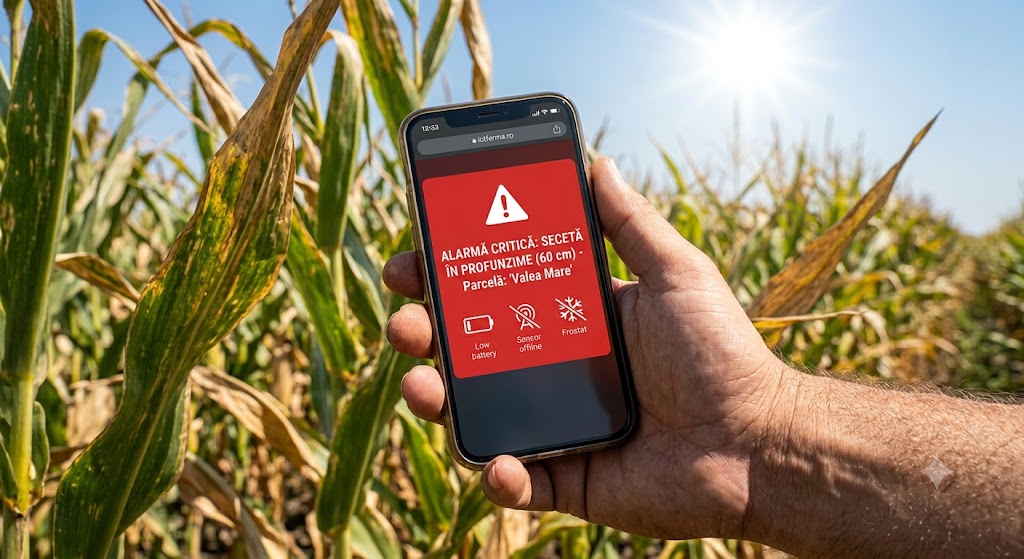
The whole point of a monitoring system is to warn you before the crop suffers. But a good system is also honest about what it cannot see — because that is exactly what helps you trust the alarms that do go off. Let’s take them one by one.
The 26 types of alarm, by category
The platform continuously tracks the readings from the soil and the weather station, compares the forecast with the crop’s growth stage, and sends alarms by email, in Romanian, sorted by severity. There are 26 types, grouped into seven categories:
- Water — drought and excess (8 types). The heart of the system. Drought at the shallow and deep sensor levels, imminent drought and an early warning (3–7 days), plus excess water at both depths — with a normal threshold and a critical threshold, for the risk of waterlogging or root suffocation.
- Temperature — frost and heatwave (5 types). Frost warning, frost risk tied to the crop’s sensitive stage (predictive, from the forecast), a heatwave relative to the crop’s stage, severe heat stress and extreme VPD (the air “pulls” water out of the plant).
- Wind and rain (2 types). Strong wind forecast — a risk of lodging in cereals and of drift when spraying — and torrential rain.
- Disease (2 types). Risk of fungal disease from humidity and temperature, plus a disease risk tied to the crop’s critical stage (for example Fusarium at wheat flowering).
- Salinity (2 types). Salinity at the shallow and deep sensor levels, on irrigated plots.
- Agronomic decisions (4 types). The need to irrigate (with a recommended dose), yield at risk (from the FAO-33 model), the optimal spraying window and soil too cold for sowing.
- Equipment (3 types). Low battery on the weather station and on the soil probes, at every depth level — so you can step in before you are left without data.
All of it with configurable quiet hours, so the soil doesn’t ring you at 3 in the morning. Each user chooses which types of alarm to receive, and the settings are saved to the account, not the browser.
Three severity levels
Every alarm comes classified, so you know how quickly you need to react:
- Critical (red) — urgent action: deep-soil drought, frost at the sensitive stage, extreme heatwave.
- Major (yellow) — attention in the coming days: the need to irrigate, heat stress, strong wind.
- Minor (blue) — to keep an eye on: the spraying window, mild salinity, soil too cold for sowing.
Critical alarms override the quiet hours; the rest wait for you in the morning.
Predictive alarms: they warn you before, not after
Beyond the thresholds measured in the soil, the Pro plan anticipates risks from the weather forecast and from phenology:
- Frost and heatwave relative to the crop’s stage — the same forecast minimum or maximum means something different at flowering than at the vegetative stage; the threshold adapts to how sensitive the crop is right now.
- Strong wind — gusts arriving in the next 48 hours, so you can secure the crop and postpone spraying.
- Risk of fungal disease — from humidity, temperature and a wet window at flowering.
- The optimal spraying window — the right moment for treatments.
These don’t wait for the problem to show up in the soil — they anticipate it from the conditions, so you can act in advance.
What the system CANNOT know
This is the part other providers skirt around. The system measures water, salt and weather — and it is very good at it. But:
- It doesn’t “see” disease directly — it only estimates the risk from the conditions (humidity, temperature). If the disease has already taken hold, it won’t detect it from the soil.
- It doesn’t catch hail, pests or mechanical damage.
- It doesn’t measure nitrogen or other soil nutrients.
In other words: it tells you when and how much to irrigate and warns you of water and weather risks — but it does not replace the agronomist’s eye for disease, pests or fertilisation.
That’s why the yield estimate carries a margin
The same honesty shows up in the season report. The yield estimate uses the FAO-33 model (yield as a function of water) — so it captures only the effect of water on the harvest, not disease, hail or a nitrogen shortfall. On irrigated plots we also add the impact of salinity, following FAO-29.
The result comes with a stated margin of ±15–20%. Not because the model is weak, but because it is honest: it is a reference point for decisions, not a guarantee. You know exactly what the figure means — and what it does not.
Why honesty matters
A farmer who knows the system’s limits trusts the alarms that do go off. A deep-soil drought alarm means something concrete and actionable; it isn’t noise, it isn’t marketing. And an estimate with an honest margin is more useful than a tidy promise that proves wrong at the weighbridge.
Good monitoring doesn’t claim to see everything. It sees exactly what it can measure — accurately, in real time, in terms you understand — and it is clear about the rest.