When to install a soil monitoring system — a season-by-season guide for Romanian farmers
One of the first questions farmers ask when they start considering a soil monitoring system is a simple one: “when is the best time to install it?” The short answer — on an empty, accessible field, right before the season when your crop demands the most water. The logic is straightforward: you want the sensors already in the ground, calibrated and recording data before you need to make your first irrigation decision, not after the plant has already started to suffer.
Below you’ll find the good windows in the year, explained by crop, plus the moments you’re better off avoiding.
Why timing matters
A monitoring system gives you the most when it runs throughout the whole growing season — especially during the phase of peak water demand. In Romania, the dry period usually falls in June–August. If you only install in July, with the crop already stressed, you’ve missed exactly the decisions that mattered: when and how much to irrigate in May and June, how quickly the soil dries out after a rain, which plot needs water first.
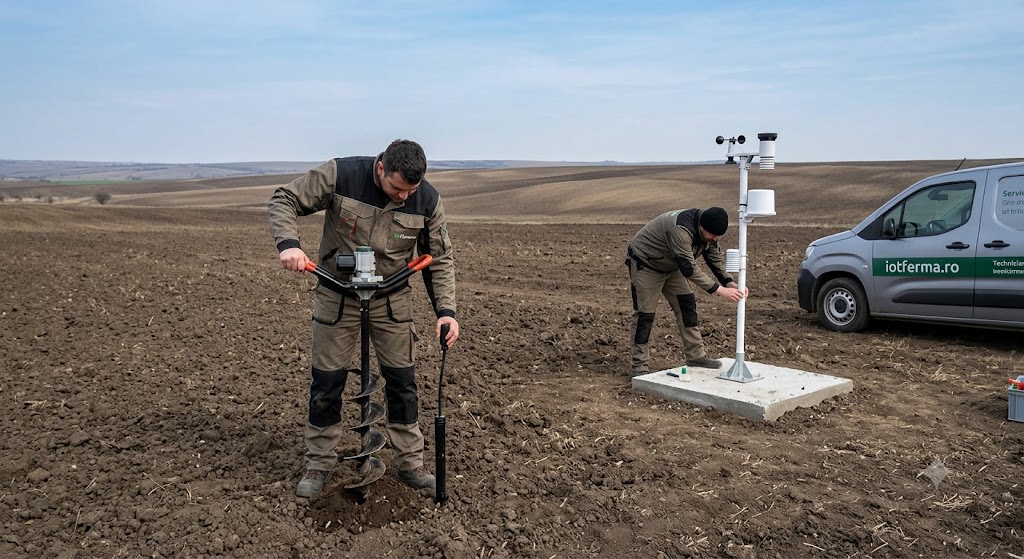
There’s another reason, a practical one: sensor calibration needs good contact between the probe and the soil, and the masts are anchored to the ground with a ground screw and ballast, without poured concrete. Both depend on soil conditions — and both turn out badly on frozen ground or in mud.
The spring window (February–March) — for spring crops
For maize, sunflower and soya, this is the ideal window:
- The soil has thawed and can be worked. The probes go in cleanly, at the depth suited to the crop — down to 80–120 cm for sunflower.
- The plots are still empty, before sowing — nothing to work around, nothing to disturb.
- The weather is mild and the soil moist. The probes make good contact with the ground, and the masts anchor easily.
- You start for the whole April–September season — exactly when the irrigation plan based on the FAO-56 method matters most.
An important bonus: if we install a few weeks before sowing, we also capture a baseline moisture value at sowing, after the soil has recharged over the winter. That baseline means everything that follows — the water balance, the drought thresholds — starts from a real measurement, not an estimate.
The autumn window (late August – September) — for autumn crops
For farms built around wheat, barley and rapeseed, the window shifts to late summer and early autumn:
- The plots are accessible after the summer harvest.
- The weather is still good for the installation work — masts, sensors, calibration.
- You capture the whole crop cycle: emergence in autumn, overwintering and the resumption of growth in spring.
What’s best to avoid
Not every moment is suitable, and it’s only fair to say so:
- The depths of winter, with frost and snow. On frozen ground the masts don’t anchor well and there’s no good contact between sensor and soil — calibration would be unreliable.
- The muddiest periods (the early thaw or heavy autumn rains). Here the problem is no longer the soil, but getting machinery onto the field to raise the 6 m mast.
- The height of the season, with the crop in the field. With maize standing tall it’s no longer easy to get in, burying the sensors disturbs the crop, and the most useful part — the early-season data — is already lost.
If you do reach us later, we’ll still install and the system starts recording straight away — it’s just that you see the full benefit from the following season, when you start with the system calibrated from day one.
Why “before the season” is an advantage, not just a convenience
The difference between monitoring and guessing lies precisely in this starting point. When the sensors are in the ground before sowing, you have:
- a measured baseline of soil water right from sowing;
- thresholds calibrated to your plot’s texture — clay doesn’t behave like sand, and the system knows that;
- a FAO-56 water balance that runs from day one, not one started halfway through the season.
In short: the irrigation decision rests on what is actually happening in your soil, not on a model started from scratch.
How far ahead to book
Ideally, one to two months ahead of the point when you want the system to be up and running. Installations pile up at the start of the season, so booking early ensures that the work falls within the window, not after it.
- For spring crops — a conversation around January–February.
- For autumn crops — around July–August.
For the same reason, the annual recalibration of the sensors falls naturally at about the same suitable point every year.
In short
| Crop | Installation window |
|---|---|
| Maize, sunflower, soya (spring) | February–March |
| Wheat, barley, rapeseed (autumn) | late August – September |
| To avoid | frost and snow, mud, the height of the season with the crop in the field |
At iotferma.ro we take care of everything — installing the masts, the weather station, the in-furrow sensors and calibration on site — and we schedule your installation before the start of the season. That way, from the first day of the season you already have a baseline in the field and calibrated sensors, not estimates.